
Workshop on Mental Health and Wellness Organised at Dimapur Government College
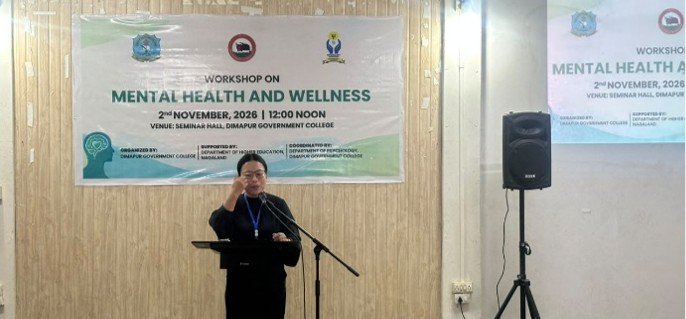
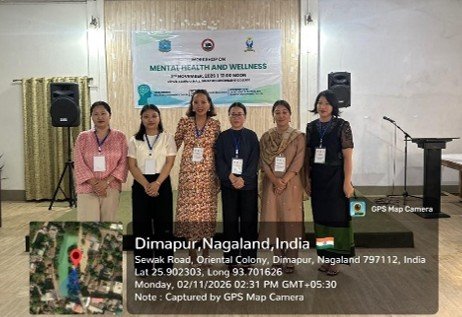
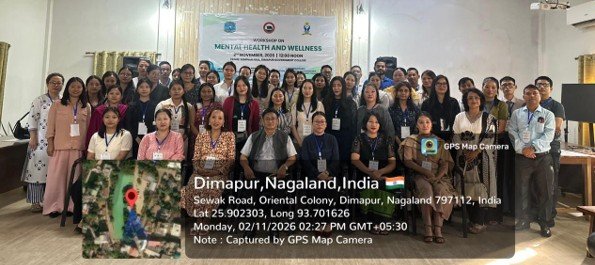
Dimapur Government College, with the support of the Department of Higher Education, Nagaland, and coordinated by the Department of Psychology, organised a workshop on “Mental Health and Wellness” on 2nd November 2026. Around 60 faculty members from various schools, colleges and university across Dimapur, including Chumoukedima and Niuland, attended the workshop, which aimed to raise awareness of mental health and wellness in educational settings.
The programme began with a welcome address by Dr. T. Tiakaba Jamir, Principal, DGC. He highlighted the growing mental stress experienced by both teachers and students due to changes in the governance system, increasing workloads and the absence of clearly defined working hours. He commended the Department of Psychology for organising the workshop and noted that, although it was primarily intended for teachers, its benefits would in turn extend to students.
The workshop featured an introductory remark on “Understanding Mental Health and Wellness” by Dr. Temsusenla Jamir, Assistant Professor and Head, Department of Psychology. She emphasised that well-being extends beyond physical health, and urged participants to reflect on three questions: How attentive are we to our own mental well-being? How do we respond when someone around us is struggling? And what kind of educational institutions are we helping to create?
The main address, titled “Promoting Mental Wellness: Practical Strategies for Well-being”, was delivered by the resource person, Dr. Lovika P. Shikhu, Assistant Professor, Department of Psychology, Nagaland University. She spoke on practical approaches to maintaining mental wellness, drawing on psychological concepts as well as her professional and personal experiences. On work–life balance, Dr. Shikhu introduced the “Four Burners Theory”, in which the four burners of a gas stove represent four areas of life: family, friends, health and work. Since it is difficult to excel in all four at once, she suggested that one must consciously prioritise, drawing on her own experience of balancing parenting and work.
She then introduced the concept of Positive Psychology and distinguished between ‘hedonia’, the pursuit of pleasure, and ‘eudaimonia’, the striving to find meaning and purpose in life. She stressed the need to align one’s skills and potential with the challenges of one’s work, and noted that the National Education Policy (NEP) reflects an understanding of student well-being by giving students the freedom to choose paths that suit them.
Referring to Abraham Maslow’s “Hierarchy of Needs”, she outlined the progression from physiological needs to safety and security, love and belongingness, self-esteem and, finally, self-actualisation, which she identified as the ultimate aim of mental well-being. She also outlined practical measures for maintaining mental wellness, including mindfulness-based stress reduction, which involves becoming aware of one’s thoughts without reacting to them immediately; cultivating spirituality; practising gratitude; prioritising adequate sleep; maintaining a balanced diet; and nurturing healthy relationships with loved ones, and the wider community.
Drawing on her professional and personal experience, Dr. Shikhu spoke briefly of the mental health challenges of motherhood, noting that postpartum trauma and antenatal depression cannot be overcome by willpower alone and that awareness of early symptoms, such as emotional instability, is essential.
The programme concluded with an interactive session which provided a platform for meaningful discussions, sharing of experiences, and practical insights into promoting mental well-being.
Miss Taba Yasi
Assistant Professor
Department of Hindi
Miss Vikitheli T. Kiba
Assistant Professor
Department of English